


Ocean Economy: Investing in the Blue Frontier
- Marko Stojanovic
- Oct 20, 2025
- 2 min read

The Next Economic Wave Is Blue
The world’s oceans cover more than 70% of the Earth’s surface, yet the economic potential of this “blue frontier” is only beginning to be tapped.From offshore wind to deep-sea mining and marine biotechnology, the ocean economy is projected to double to $3 trillion by 2030. As climate change, seafood demand, and energy transitions reshape markets, new investment opportunities are emerging.

Key Growth Areas in the Ocean Economy
Offshore Wind Energy
Offshore wind capacity is expected to increase fivefold by 2030, driven by Europe, China, and the U.S.
Companies like Ørsted, Siemens Gamesa, and Vestas are leading developers and turbine manufacturers.
Floating wind technology is unlocking new deep-water locations previously unreachable.
Deep-Sea Mining
Rich deposits of cobalt, nickel, and rare earth minerals lie on the seabed.
These are critical for EV batteries and renewable infrastructure.
Companies like The Metals Company ($TMC) are developing technology to mine polymetallic nodules sustainably (though regulatory debates continue).
Marine Biotechnology
Oceans host over 90% of the planet’s biodiversity, offering untapped potential for pharmaceuticals, cosmetics, and food innovation.
Algae-based proteins, marine enzymes, and gene sequencing are driving innovation in health and industry.
Sustainable Seafood & Aquaculture
Global seafood demand is expected to grow 30% by 2030, but wild fish stocks are declining.
Aquaculture (fish farming) and sustainable fisheries are expanding to meet demand.
Companies like Mowi ASA, Bakkafrost, and Grieg Seafood are leading the shift.
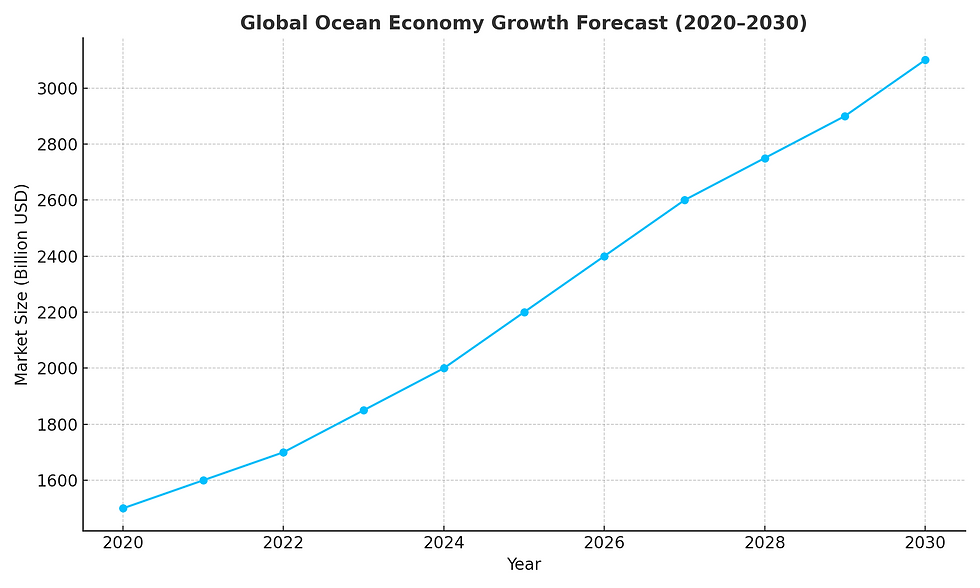
Market Outlook: Ocean Economy by 2030
Sector | 2025 Market Size | 2030 Forecast | Key Drivers |
Offshore Wind | $40B | $200B | Energy transition & floating wind tech |
Deep-Sea Mining | $0B (pre-commercial) | $30B+ | Critical minerals for EVs |
Marine Biotech | $15B | $80B | Pharmaceuticals & cosmetics |
Aquaculture | $280B | $400B | Rising seafood demand |
Shipping & Ports | $450B | $600B | Global trade & green shipping tech |
Sources: OECD, IEA, FAO projections
Investment Vehicles & Funds
iShares Global Clean Energy ETF ($ICLN) – Offshore wind exposure through major developers.
VanEck Rare Earth/Strategic Metals ETF ($REMX) – Exposure to critical mineral suppliers including seabed mining plays.
Ocean 14 Capital Fund – A private fund focusing on sustainable oceans and marine innovation.
ARKX (Space & Innovation ETF) – Indirect exposure through satellite monitoring and maritime tech.

Risks to Consider
Environmental Regulations: Offshore and seabed activities face scrutiny and potential delays.
Technological Uncertainty: Deep-sea mining and floating wind tech are still early-stage.
Geopolitical Control: Ocean resources often overlap with territorial waters, creating regulatory and diplomatic risks.
Investment Strategy
Focus on Offshore Wind Leaders: Ørsted, Siemens Gamesa, and Vestas are already profitable and expanding globally.
Take Selective Bets on Emerging Tech: Marine biotech and seabed mining offer high upside but carry risk—ETFs help diversify.
Sustainability Matters: Funds focusing on sustainable ocean practices may outperform as regulation tightens.

Final Thought
The Ocean Economy represents a massive, underexplored frontier. As climate change accelerates the transition to renewables, and seafood and biotech industries expand, the blue frontier is becoming a strategic investment theme for the 2025–2035 decade.
For investors who look beyond the surface, the ocean holds not just ecological value—but financial opportunity.
👉 Follow me on eToro to see how I’m positioning for the rise of the Blue Economy.


Comments