


The Rise of Retail Investors: How Social Trading Platforms Are Beating Hedge Funds
- Marko Stojanovic
- Sep 7, 2025
- 3 min read

Updated: Sep 8, 2025
A Quiet Revolution in Investing
For decades, Wall Street was controlled by hedge funds, investment banks, and big institutions with billions under management. Retail investors — everyday people trading their own money — were often dismissed as “amateurs.”
But over the past decade, something changed. Retail investors have not only grown in numbers but also started outperforming traditional money managers in surprising ways. Platforms like eToro, Robinhood, and decentralized finance apps have given individuals access to tools, knowledge, and markets once reserved for the elite.

The GameStop Shockwave
The turning point came in early 2021, when millions of small investors banded together during the GameStop short squeeze. Hedge funds lost billions, while retail investors proved they could move markets.
According to Bloomberg, retail trading volume in the U.S. doubled between 2019 and 2021, accounting for nearly 25% of all equity trades. What started as a Reddit movement became a global wake-up call: individual investors were no longer background noise.
Technology Levels the Playing Field
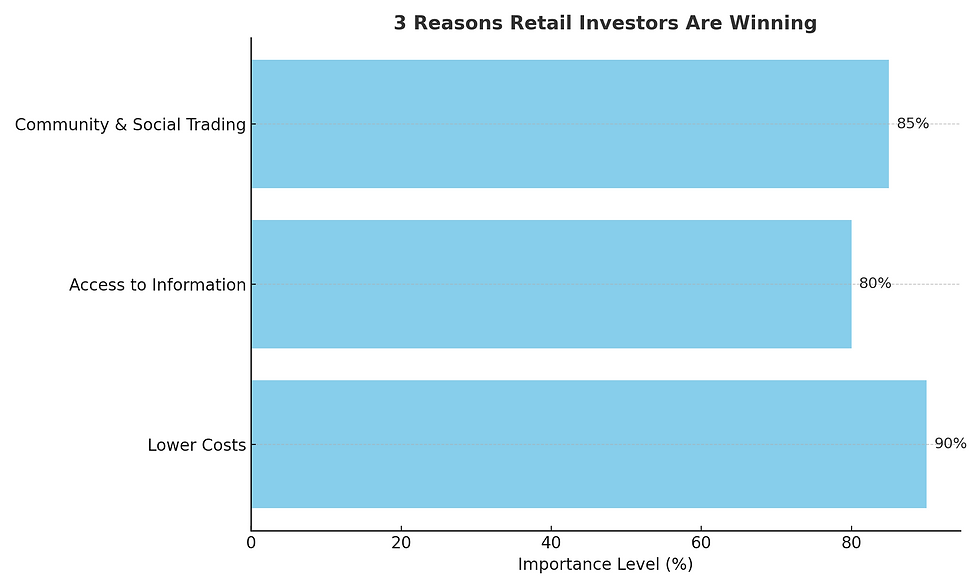
Why is this happening now? Three big shifts explain the rise of retail investors:
Zero-Commission Trading → Platforms like Robinhood and eToro cut costs, making it possible for anyone to start with $10 instead of $10,000.
Access to Information → Social media, YouTube, and Substack have democratized financial education. Investors today learn strategies online instead of paying for private hedge fund reports.
Social Trading & Copy Trading → Platforms like eToro allow retail traders to copy successful investors in real time, giving them instant access to strategies that were once locked behind hedge fund doors.

Retail vs Hedge Funds: The Numbers
Hedge Fund Performance: According to HFR (Hedge Fund Research), the average hedge fund has returned about 6–7% annually over the past decade.
Retail Investors: Studies from Charles Schwab and eToro show that some retail portfolios, especially those using copy trading and diversified ETFs, have been delivering 8–12% returns — with lower fees.
Hedge funds also charge “2 and 20” fees (2% of assets + 20% of profits), while retail investors on platforms often pay close to zero management fees. That difference compounds massively over time.

The Power of Social Trading
The unique advantage of retail investors today is community.
On platforms like eToro, you don’t just trade alone — you learn from others, copy proven strategies, and share your own insights. This network effect creates something hedge funds don’t have: collective intelligence.
Copy trading, in particular, has created a new class of financial leaders known as Popular Investors. By sharing their real portfolios transparently, they build trust and attract thousands of copiers, effectively becoming “mini hedge funds” run by individuals.
What It Means for the Future
By 2030, we could see retail investors controlling over 30% of global assets under management. Hedge funds won’t disappear, but the monopoly on financial expertise is gone forever.
Instead, we will see a hybrid world:
Institutions adopting social features to stay relevant.
Retail platforms offering AI-driven tools to empower investors even more.
A generation of Popular Investors rising as trusted financial voices.
My View as a Popular Investor
As someone building a transparent portfolio on eToro, I believe this shift is just beginning. People don’t just want numbers — they want trust, clarity, and accessibility.
Retail investing is no longer a side game. It is the future of finance. And with platforms like eToro leading the charge, the next “big money manager” could be someone you’ve never heard of — until you start copying their trades.
👉 Follow me on eToro to see my portfolio in real time and join the community of retail investors rewriting the rules of Wall Street.


Comments